Japan Vowed Never to Declare War Again
Commodity 9 of the Japanese Constitution ( 日本国憲法第9条 , Nihonkokukenpō dai kyū-jō ) is a clause in the national Constitution of Japan outlawing war equally a ways to settle international disputes involving the state. The Constitution came into effect on 3 May 1947, post-obit Earth War 2. In its text, the state formally renounces the sovereign right of belligerency and aims at an international peace based on justice and order. The article as well states that, to accomplish these aims, armed forces with state of war potential will not exist maintained. The Constitution was imposed by the occupying United States in the post-World War II menstruum.[1]
Despite this, Japan maintains the Nippon Self-Defense Forces, a de facto defensive regular army with strictly offensive weapons like ballistic missiles and nuclear weapons prohibited.
In July 2014, instead of using Commodity 96 of the Japanese Constitution to meliorate the Constitution itself, the Japanese government approved a reinterpretation which gave more powers to the Nihon Self-Defense Forces, allowing them to defend other allies in instance of war being declared upon them, despite concerns and disapproval from Prc and North korea, whereas the United States supported the motion. This change is considered illegitimate by some Japanese political parties and citizens, since the Prime Government minister circumvented Japan's constitutional amendment procedure.[2] [3] [4] In September 2015, the Japanese National Diet made the reinterpretation official by enacting a serial of laws allowing the Japan Self-Defense Forces to provide material support to allies engaged in gainsay internationally. The stated justification was that failing to defend or support an ally would weaken alliances and endanger Japan.[5]
Text of the article [edit]
The full text of the article in Japanese:[6]
日本国憲法第九条 第1項 日本国民は、正義と秩序を基調とする国際平和を誠実に希求し、国権の発動たる戦争と、武力による威嚇又は武力の行使は、国際紛争を解決する手段としては、永久にこれを放棄する。
第2項 前項の目的を達するため、陸海空軍その他の戦力は、これを保持しない。国の交戦権は、これを認めない。
The official English translation[seven] of the article is:
ARTICLE 9. (1) Aspiring sincerely to an international peace based on justice and order, the Japanese people forever renounce war equally a sovereign right of the nation and the threat or apply of strength as ways of settling international disputes.
(two) In club to attain the aim of the preceding paragraph, land, sea, and air forces, likewise every bit other war potential, volition never be sustained. The right of belligerency of the state will not be recognized.
Historical groundwork [edit]
The failure of the collective security of the League of Nations led to the realization that a universal arrangement of security could only be effective if nations agreed to some limitation of their national sovereignty with regard to their correct to belligerency, and if the Security Quango which had been a "closed shop" during League of Nations times, would open itself upwards to UN Members who would cede constitutional powers in favor of collective security. Like the German Article 24, which was incorporated in the mail service-war German Constitution, and which provides for delegating or limiting sovereign powers in favor of collective security,[8] Article ix was added to the Constitution of Japan during the occupation post-obit World War Two.
The source of the pacifist clause is disputed. According to the Allied Supreme Commander Douglas MacArthur (in statements made at a time when the U.South. was trying to go Japan to re-arm), the provision was suggested by Prime Government minister Kijūrō Shidehara,[ix] who "wanted information technology to prohibit whatsoever military establishment for Nippon—whatever armed forces institution whatsoever".[10] Shidehara'southward perspective was that retention of arms would be "meaningless" for the Japanese in the post-war era, considering any substandard post-war military would no longer proceeds the respect of the people, and would actually cause people to obsess with the subject of rearming Nippon.[xi] Shidehara admitted to his authorship in his memoirs Gaikō Gojū-Nen (L Years' Affairs), published in 1951, where he described how the thought came to him on a train journey to Tokyo; MacArthur himself confirmed Shidehara's authorship on several occasions. Even so, co-ordinate to some interpretations, he denied having done so,[12] and the inclusion of Article 9 was mainly brought about by the members of the Regime Section of the Supreme Commander for the Allied Powers, especially Charles Kades, i of Douglas MacArthur'southward closest assembly. There is, even so, another theory by constitutional scholar Toshiyoshi Miyazawa, which is supported by meaning evidence provided past other historians, that the idea came from MacArthur himself and that Shidehara was merely a pawn in his plans.[13] [ romanization needed ]
The House of Representatives amended the Article and added "Aspiring sincerely to an international peace based on justice and order," to Paragraph i and "In guild to accomplish the aim of the preceding paragraph," to Paragraph ii. Hitoshi Ashida made this tenor. SCAP did not object to this amendment. Many scholars retrieve the Authorities of Nippon does non renounce the right (to have ability) of self-defense because of this subpoena. [nb 1] [xiv] [fifteen] [16] [17]
The article was endorsed by the Nutrition of Japan on 3 November 1946. Kades subsequently fabricated statements, like MacArthur at a time when the U.S. was trying to go Japan to rearm, that suggested he had initially rejected the proposed language that prohibited Nihon's utilise of force "for its own security", believing that self-preservation was the right of every nation.[eighteen] The historical record, however, casts doubt on this revisionist interpretation. [nineteen]
Interpretation [edit]

Before long later the adoption of the Constitution of Nihon in 1947, the Chinese Ceremonious War ended in victory for the Chinese Communist Party in 1949 and the establishment of the People's Republic of China (PRC). As a consequence, the United States was left without the Republic of Prc (ROC) on Mainland Cathay as a military ally against communism in the Pacific. There was a desire on the part of the United States occupation forces for Japan to have a more active military role in the struggle against communism during the Cold State of war.[20]
If Article 9 is looked upon as a motion to cancel war as an establishment—equally envisaged in the 1961 McCloy–Zorin Accords—and then the Korean crisis was the first opportunity for some other country to second the Japanese motion and embark on the transition toward a truthful system of collective security under the United Nations. In fact, however, in 1950, post-obit the outbreak of the Korean State of war, the U.S. 24th Infantry Partition was pulled out of Japan and sent to fight on the front end lines in Korea, and so Nippon was left without any armed protection. MacArthur ordered the creation of a 75,000-strong National Police Reserve ( 警察予備隊 , Keisatsu yobitai ) to maintain gild in Japan and repel any possible invasion from exterior. The NPR was organized by United States Army Col. Frank Kowalski (later a U.S. congressman) using Army surplus equipment. To avoid possible constitutional violations, armed services items were given civilian names: tanks, for instance, were named "special vehicles".[21] Shigesaburo Suzuki, a leader of the Nihon Socialist Party, brought suit in the Supreme Court of Japan to have the NPR declared unconstitutional: however, his case was dismissed by the Grand Bench for lack of relevance.[22]
On ane Baronial 1952, a new National Safety Agency ( 保安庁 , Hoancho ) was formed to supervise the NPR and its maritime component. The new agency was directly headed by Prime Government minister Shigeru Yoshida. Yoshida supported its constitutionality: although he stated in a 1952 Nutrition committee session that "to maintain war potential, fifty-fifty for the purpose of self-defence, [would] necessitate revision of the Constitution". He subsequently responded to the JSP's constitutionality claims by stating that the NSF had no true state of war potential in the modern era.[21] In 1954, the National Safety Agency became the Japan Defense Agency (now Ministry building of Defence force), and the National Police Reserve became the Japan Self-Defence Forces ( 自衛隊 , Jieitai ).
In practise, the Japan Self-Defense Forces (JSDF) are very well equipped and the maritime forces are considered to be stronger than the navies of some of Nihon's neighbors.[ citation needed ] The Supreme Court of Japan has reinforced the constitutionality of armed self-defense in several major rulings, most notably the Sunakawa Example of 1959, which upheld the legality of the then-electric current U.S.–Japan Security Treaty.
In July 2014, Japan introduced a reinterpretation which gave more powers to its Self-Defense forces, allowing them to defend other allies in case of state of war alleged upon them. This move potentially ends Japan's long-standing pacifism and drew heavy criticism from China and North Korea, while the United States supported this move.
In September 2015, the Japanese National Nutrition made the reinterpretation official by enacting a series of laws allowing the Japan Cocky-Defence force Forces to provide cloth back up to allies engaged in combat internationally. The stated justification was that failing to defend or support an ally would weaken alliances and endanger Nippon.[23]
Debate [edit]

A demonstration in favor of maintaining Article nine, in front of Tabata Station, in Tokyo. (2012)
Commodity 9 of the Constitution of Nippon is all-time understood as having three singled-out elements: (one) a provision that prohibits the use of force (paragraph one); (2) a provision that prohibits the maintenance of armed forces or "other state of war potential" (paragraph 2, clause one); and (three) a denial of the rights of belligerency. [24] It is helpful to keep these distinct elements in mind in because the operation and event of Article 9. Paragraph 1, which prohibits the use of forcefulness has been highly effective in constraining Japanese foreign policy, with the outcome that Japan has non used force or been engaged in armed conflict since the promulgation of the Constitution. During the Gulf State of war of 1991, the government of Nihon sought to bring together the U.South. coalition formed to drive Iraq out of Kuwait, simply was informed by the Director of the Cabinet Legislation Bureau that doing so would constitute a apply of force in violation of Article ix paragraph 1 - so Nippon was limited to providing financial assistance. [25]
The 2nd chemical element of Article 9, which prohibits Japan from maintaining an army, navy or air force, has been highly controversial, and arguably less constructive in shaping policy. From one perspective, 1 implication of the provision is that In strictly legal terms, the Japan Self-Defense Forces are not land, sea or air forces, but are extensions of the national law strength. This has had wide implications for strange, security and defense policy. According to the Japanese government, "'war potential' in paragraph two means force exceeding a minimum level necessary for self-defense. Anything at or beneath that level does not constitute war potential."[26] Apparently when the JSDF was created, "since the capability of the JSDF was inadequate to sustain a modern war, information technology was not state of war potential".[27] Seemingly, the Japanese government has looked for loopholes in the wording of the peace clause and the "constitutionality of the Japanese armed services has been challenged numerous times".[28] Some Japanese people believe that Japan should be truly pacifist and claim that the JSDF is unconstitutional. The Supreme Court, however, has ruled that it is within the nation's right to have the capacity to defend itself. Scholars accept also discussed "constitutional transformation ... [which] occurs when a constitutional provision has lost its effectiveness but has been replaced by a new significant".[29]
The Liberal Democratic Party has advocated irresolute the context of Article 9 since 1955, when Commodity 9 was interpreted as renouncing the use of warfare in international disputes but not the internal utilise of force for the purpose of maintaining law and order. However, the LDP's longtime coalition partner Komeito accept long opposed changing the context of Article 9. Also, the LDP never accept supermajority (2-thirds of votes in both Houses) in the National Diet to change the Constitution, despite it having a supermajority with Komeito from 2005 to 2009 and from 2012 to the present day.
The opposing party, the Constitutional Autonomous Party of Nihon, tends to concur with the LDP'due south interpretation. At the same fourth dimension, both parties take advocated the revision of Article 9 past adding an extra clause explicitly authorizing the use of force for the purpose of cocky-defense against aggression directed confronting the Japanese nation. The Japan Socialist Political party, on the other manus, had considered the Nippon Self-Defense Forces (JSDF) as unconstitutional and advocated the full implementation of Commodity ix through the demilitarization of Nippon. When the party joined with the LDP to form a coalition authorities, information technology reversed its position and recognized the JSDF as a construction that was constitutional. The Japanese Communist Party considers the JSDF unconstitutional and has called for reorganization of Japanese defense policy to feature an armed militia.
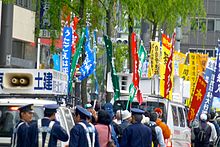
Nobori flags held by a group of pro-Article nine demonstrators and their police force escort, near Ginza. (2014)
The interpretation of Article nine, has been determined that Japan cannot agree offensive military machine weapons; this has been interpreted to mean that Nippon cannot have ICBMs, nuclear weapons, shipping carriers or bomber fleets. This has not inhibited the deployment of submarines, AEGIS-equipped destroyers, a helicopter carrier, and fighter aircraft, which have essentially more than defensive potential.
Since the late 1990s, Article 9 has been the central feature of a dispute over the ability of Japan to undertake multilateral armed forces commitments overseas. During the late 1980s, increases in authorities appropriations for the JSDF averaged more than than 5% per year. By 1990 Japan was ranked third, behind the then-Soviet Union and the Usa, in full defense force expenditures, and the U.s.a. urged Nippon to assume a larger share of the burden of defense of the western Pacific. (Japan has a guideline of a limit of ane% of Gross domestic product on defense spending; nonetheless, Nippon defines a number of activities as non-defence spending.) Given these circumstances, some have viewed Article ix as increasingly irrelevant. It has remained, nonetheless, an important brake on the growth of Japan'due south military capabilities. Despite the fading of biting wartime memories, the full general public, according to opinion polls,[xxx] connected to show stiff support for this constitutional provision.
The different views can be clearly organized into four categories:
- The current pacifists believe in maintaining Article 9 and claim the JSDF is unconstitutional, and would like to detach Nippon from international wars.
- The mercantilists have divided opinions about Article 9 although the interpretation is broadened to include the JSDF, and believe that the JSDF's part should be retained to activities related to the United Nations and for non-combat purposes. They advocate minimal defense spending, and emphasize economic growth.
- The normalists "telephone call for incremental armament for national defense and take using military force to maintain international peace and security". They back up the revision of Article ix to include a clause explaining the existence and part of the JSDF.
- The nationalists assert that Japan should remilitarize and build nuclear capabilities in guild to regain pride and independence. They too abet revision of Article 9 to promote armament.
Evidently, opinions range from one extreme of pacifism, to the other extreme of nationalism and complete remilitarization.[31] The majority of Japanese citizens approve the spirit of Commodity 9 and consider it personally important.[32] [33] But since the 1990s, there has been a shift away from a stance that would tolerate no alteration of the commodity to allowing a revision that would resolve the discord between the JSDF and Article nine.[34] [35] Additionally, quite a few citizens consider that Japan should let itself to commit the Japan Self-Defense Forces to collective defense force efforts, similar those agreed to on the UN Security Council in the Gulf State of war, for case.[36] Japan's ability to "engage in collective defense" has been argued.[37] The involvement of Japan in the Gulf War of 1990, or lack of involvement, has provoked significant criticism. Despite U.S. pressure on Nippon to assist America in Iraq, Japan limited their interest in the war to financial contribution primarily considering of domestic opposition to the deployment of troops.[38] As a consequence of the painfully ardent disapproval from the U.S. during the Gulf War, Japan was quick to human activity later the September 11 attacks in 2001. It was clear that "the 11 September attacks led to increased U.Due south. demands for Japanese security cooperation".[39] On October 29, 2001, the Anti-Terrorism Special Measures Law was passed, which "farther broadened the definition of Nihon'due south self-defence force".[40] The police force allowed Japan to support the U.S. military on foreign territory. This police provoked "citizen groups [to] file lawsuits confronting the Japanese government in order to finish the dispatch of JSDF troops to Republic of iraq and to ostend the unconstitutionality of such a dispatch",[41] though the troops sent to Republic of iraq were not sent for combat but for humanitarian aid. Japan has actively congenital U.S.-Japan relations precisely because of Article nine and Japan'due south inability to engage in an offensive war. It has been debated that, "when [Koizumi] declared support for the U.Due south.-led war on Iraq in March 2003, and when he sent Japanese forces to assist the occupation in Jan 2004, information technology was not Republic of iraq that was in the Japanese sights so much as N Korea".[42] Nippon'due south unstable relations with North korea, equally well as other neighboring Asian countries has forced Nippon to batter and bend Article 9 to "permit an increasingly expansive estimation" of the constitution in the hopes of guaranteeing U.Due south. support in these relations.[43]
Former Prime number Minister Nobusuke Kishi said in a speech, he called for abolishing Article 9, saying if Japan were to get a: "respectable member (of) the community of nations it would starting time have to revise its constitution and rearm: If Nihon is lone in renouncing state of war ... she will not be able to prevent others from invading her land. If, on the other hand, Japan could defend herself, there would be no further demand of keeping Usa garrison forces in Nihon. ... Japan should be strong plenty to defend herself."[44]
In May 2007, the and then Prime Minister of Japan Shinzō Abe marked the 60th ceremony of the Japanese Constitution by calling for a "bold review" of the certificate to allow the state to accept a larger role in global security and foster a revival of national pride.[45] Aside from Abe'south Liberal Autonomous Political party, equally of 2012, the Nihon Restoration Party, Democratic Political party of Nihon, People's New Political party, and Your Party support a constitutional amendment to reduce or abolish restrictions imposed by Article ix.[46]
On vii September 2018, candidate in the 2018 LDP Leadership Election, Shigeru Ishiba criticized Shinzo Abe for shifting his opinion on Commodity ix revision. Ishiba advocates the removal of Paragraph two of Article 9 which denies Japan'southward "correct of belligerency." This is based on a LDP typhoon of changes for the law in 2012. In May 2017, Abe inverse his opinion to keep both the first and second paragraph of commodity nine while adding a reference to the Nippon Cocky-Defence force Forces.[47]
In January 2019, former Prime Minister Shinzo Abe said in the National Diet that long-range prowl missiles are not banned under Article 9 of the Constitution.[48]
On 21 October 2019 a senior U.Due south. military officer in Tokyo said that "Japan's avoidance of offensive weaponry under its constitution is no longer acceptable." The officer stated that Japan needs to rethink its rejection of offensive weapons and that the government should talk over information technology with the public. The officer said that the government of Japan should inform the public about the threats of China and Democratic people's republic of korea.[49]
A constitutional amendment would crave a two-thirds majority and laissez passer plebiscite to effect it (as per Article 96 of the Japanese Constitution). Despite numerous attempts by the LDP to change Commodity ix, they have never been able to accomplish the large majority required, as revision is opposed by a number of Japanese parties including the DPJ and the Japanese Communist Party.
International comparisons [edit]
In the Italian Constitution Article xi is similar to the Japanese analogue, simply the apply of military forces is permitted for self-defense force (articles 52 and 78) and also for peace-keeping purposes, if agreed with international organizations:
Italian:
L'Italia ripudia la guerra come up strumento di offesa alla libertà degli altri popoli e come mezzo di risoluzione delle controversie internazionali; consente, in condizioni di parità con gli altri Stati, alle limitazioni di sovranità necessarie ad un ordinamento che assicuri la pace e la giustizia fra le Nazioni; promuove eastward favorisce le organizzazioni internazionali rivolte a tale scopo.
English translation:[50]
Italy repudiates state of war equally an musical instrument offending the liberty of the peoples and as a means for settling international disputes; it agrees to limitations of sovereignty where they are necessary to let for a legal system of peace and justice between nations, provided the principle of reciprocity is guaranteed; information technology promotes and encourages international organizations furthering such ends.
The Article 12 of the Constitution of Costa rica enacted in 1949 establishes:
Se proscribe el Ejército como institución permanente. Para la vigilancia y conservación del orden público, habrá las fuerzas de policía necesarias. Sólo por convenio continental o para la defensa nacional podrán organizarse fuerzas militares; unas y otras estarán siempre subordinadas al poder civil; no podrán deliberar, ni hacer manifestaciones o declaraciones en forma private o colectiva.
English translation:[51]
The Army as a permanent establishment is abolished. There shall be the necessary police forces for surveillance and the preservation of the public order. Military forces may only exist organized nether a continental agreement or for the national defense; in either example, they shall e'er exist subordinate to the civil power: they may not deliberate or brand statements or representations individually or collectively.
The German Constitution emphasizes the obligations of International Law as existence part - and taking precedence within - federal constabulary (Art. 25 GG) and forbids international acts of aggression, including offensive wars (Art. 26 GG). It does not, withal, forbid a standing military machine.
Article 5 of the South Korean constitution, last amended in 1986, states:
① 대한민국은 국제평화의 유지에 노력하고 침략적 전쟁을 부인한다.
② 국군은 국가의 안전보장과 국토방위의 신성한 의무를 수행함을 사명으로 하며, 그 정치적 중립성은 준수된다.
English language Translation:
1. The Republic of korea shall endeavor to maintain international peace and shall renounce whatever war of aggression.
2. The national Armed Forces shall be charged with the sacred mission of national security and the defense of the country and their political neutrality shall exist observed.
Reinterpretation in 2014 [edit]
In July 2014, Nihon'southward government canonical a reinterpretation of this commodity. This reinterpretation would allow Nippon to do the right of "collective self-defense"[ii] in some instances and to engage in war machine activeness if ane of its allies were to be attacked.[3] It is considered by some parties as illegitimate, posing a serious danger to Nihon'southward democracy since the Prime number Minister circumvented the ramble amendment procedure, dictating a radical change to the meaning of fundamental principles in the Constitution by way of Chiffonier fiat without Diet debate, vote, or public blessing.[4] International reaction to this move was mixed. Mainland china expressed a negative view of this reinterpretation, while the US, Philippines, Vietnam, and Indonesia reacted positively. The government of South Korea did not oppose the reinterpretation, but noted that it would not approve of JSDF operations in and effectually the Korean peninsula without its asking or blessing, and called upon Japan to act in a manner that would win the trust of neighboring states.
In May 2017, Japanese Prime Minister Abe set a 2020 deadline for revising Article 9, which would legitimize the JSDF in the Constitution.[52] [53] [54] [55] Abe retired in 2020 due to wellness problems without revising Article 9.
See besides [edit]
- Commodity 9 of the Japanese Constitution Referendum
- Article 12 of the Constitution of Costa rica
- Gilded Week
- Constitution Memorial 24-hour interval
- The Nobel Peace Prize for Commodity nine of the Japanese Constitution
- Japanese people who conserve Commodity 9
- 2015 Japanese military legislation
- Japan Self-Defense Forces
- Japanese Republic of iraq Reconstruction and Support Group
- Nippon and the United Nations
- Reform of the United Nations Security Council#Japan
- Japanese Peace Bell
- Perpetual peace
- Kellogg–Briand Pact
References [edit]
 This commodity incorporates text from this source, which is in the public domain . Nippon: A country study. Federal Inquiry Division.
- ^ "Resurgent Japan military machine 'can stand toe to toe with everyone". CNN. 7 December 2016. Archived from the original on iv December 2018.
- ^ a b "Nippon takes historic step from mail-state of war pacifism, OKs fighting for allies". Reuters. 1 July 2014. Retrieved 10 July 2014.
- ^ a b "How Japan tin can use its military after policy change". Independent Tape. one July 2014. Archived from the original on 7 July 2014. Retrieved 10 July 2014.
- ^ a b "Reinterpreting Article 9 endangers Japan'south rule of law". The Japan Times. 27 June 2014. Retrieved x July 2014.
- ^ Nihon enacts major changes to its cocky-defense laws eighteen September 2015
- ^ "日本国憲法". Archived from the original on 1 July 2018. Retrieved 4 Dec 2018.
- ^ "The Constitution of Japan". Prime Minister of Nihon and His Cabinet. Retrieved 29 June 2014.
- ^ Klaus Schlichtmann, Article Nine in Context – Limitations of National Sovereignty and the Abolition of War in Constitutional Law, The Asia-Pacific Journal, Vol. 23-6-09, eight June 2009 - See more at: http://japanfocus.org/-klaus-schlichtmann/3168#sthash.6iVJNGnx.dpuf
- ^ Klaus Schlichtmann, Nippon in the World: Shidehara Kijūrō, Pacifism and the Abolition of War, Lanham, Bedrock, New York, Toronto etc., ii vols., Lexington Books, 2009. See also, past the aforementioned author, "A Statesman for The Twenty-First Century? The Life and Diplomacy of Shidehara Kijūrō (1872–1951)", Transactions of the Asiatic Club of Japan, fourth series, vol. 10 (1995), pp. 33–67
- ^ Douglas MacArthur, Reminiscences (1964), p. 302.
- ^ Kijūro Shidehara, 外交の五十年 (Gaikō Gojū-Nen, "50 Years' Diplomacy") (1951), pp. 213-214.
- ^ See, east.g., Robert A. Fisher, "Note: The Erosion of Japanese Pacifism: The Constitutionality of the U.Due south.-Nihon Defense Guidelines", Cornell International Law Journal 32 (1999), p. 397.
- ^ 宮沢俊義・芦部信喜補訂『コンメンタール全訂日本国憲法』日本評論社、1978年、167頁. Run into also, Ray Moore and Donald Robinson, Partners for Democracy: Crating the New Japanese State Under MacArthur (2002); and Koseki Shoichi, The Nascency of Nihon's Postwar Constitution (1997)
- ^ Hideki SHIBUTANI(渋谷秀樹)(2013) Japanese Ramble Law. 2nd ed.(憲法 第2版) pp.70-1 Yuhikaku Publishing(有斐閣)
- ^ "衆憲資第90号「日本国憲法の制定過程」に関する資料" (PDF). Commission on the Constitution, The House of Representatives, Japan . Retrieved 1 September 2020.
- ^ "衆憲資第37号 憲法第9条 特に、自衛隊のイラク派遣並 びに集団的安全保障及び集団的自衛権」に関する基礎的資料" (PDF). The House of Representatives, Japan . Retrieved 18 Jan 2022.
- ^ "4-11 Far Eastern Commission, "Further Policies relating to a New Japanaese Constitution" and Civilians' Clause". National Diet Library, Japan . Retrieved 2 September 2020.
- ^ Edward J. 50. Southgate, "From Japan to Transitional islamic state of afghanistan: The U.South.-Japan Joint Security Relationship, The War on Terror and the Ignominious End of the Pacifist State?" Archived 25 June 2006 at the Wayback Automobile, University of Pennsylvania Law Review 151, p. 1599.
- ^ See Moore and Robinson, Partners for Democracy, supra.
- ^ Hayes, Louis D. (2001). Nihon and the Security of Asia. Lexington Books. pp. 81–82. ISBN9780739102954.
- ^ a b James Eastward. Auer, "Article Nine of Japan's Constitution: From Renunciation of Armed Forcefulness 'Forever' to the Third Largest Defence Budget in the World", Police force and Contemporary Problems 53 (1990).
- ^ 6 Minshu 783 (viii October 1950).
- ^ Erik Slavin. "Japan enacts major changes to its cocky-defence force laws". Stars and Stripes, eighteen September 2015. Accessed 26 March 2018.
- ^ Craig Martin, "Binding the Dogs of War: Japan and the Constitutionalizing of Jus ad Bellum," 30 Univ. of Pennsylvania J. Int'l Law 267 (2008) url=https://papers.ssrn.com/sol3/papers.cfm?abstract_id=1296667
- ^ Craig Martin, "Binding the Dogs of War," supra at p. 342-43; run into also Kenneth Pyle, Japan Rising: The Resurgence of Japanese Power and Purpose (2007) at p. 290-91, and Teshima Ryuichi, 1991 Nihon no Haiboku [Japan'south Defeat in 1991] (1993).
- ^ Chinen, Mark A. "Article Nine of Japan's Constitution: From Renunciation of Armed Forces "Forever" to the Third Largest Defense Budget in the Earth". Michigan Journal of International Constabulary 27 (2005):60
- ^ Hayes, Louis D. Japan and the Security of Asia. New York: Lexington Books, 2002:82
- ^ Port, Kenneth L. "Article 9 of the Japanese Constitution and the Rule of Law". Cardozo Periodical of International and Comparative Law thirteen (2004):130
- ^ Pence, Catechism. "Reform in the Rising Sun: Koizumi's Bid to Revise Japan'due south Pacifist Constitution". N Carolina Periodical of International Law and Commercial Regulation 32 (2006):373
- ^ "69% oppose alter to Japanese Constitution's war-renouncing Article ix, poll shows". The Japan Times. 22 June 2020. Archived from the original on 1 July 2020.
- ^ Hirata, Keiko. "Who Shapes the National Security Argue? Divergent Interpretations of Japan'south Security Role". Asian Diplomacy (2008): 123–151
- ^ Hajime Imai, 「憲法九条」国民投票 (Kenpō-Kyū-Jō" Kokumin-Tōhyō, "A Referendum on Article 9 of the Japanese Constitution"), 集英社新書 (Shū-Ei-Sha-Shin-Sho), October 10, 2003, pp. 31–38. 「憲法九条」国民投票
- ^ Hikaru Ōta and Shin-Ichi Nakazawa, 憲法九条を世界遺産に (Kenpō-Kyū-Jō wo Sekai-Isan ni, "Let'due south Annals Article 9 of the Japanese Constitution every bit a World Heritage Site"), 集英社新書 (Shū-Ei-Sha-Shin-Sho), Baronial 17, 2006, 憲法九条を世界遺産に
- ^ Hajime Imai 「憲法九条」国民投票 (Kenpō-Kyū-Jō Kokumin-Tōhyō, "A Plebiscite on Article 9") 集英社新書 (Shū-Ei-Sha-Shin-Sho), Oct 10, 2003, pp. 11–38.
- ^ 憲法9条と自衛隊の現実 Archived 2012-06-30 at archive.today (Kenpō-Kyū-Jō to Jiei-Tai no Genjitsu, "Article 9 of the Japanese Constitution and the bodily weather condition of the Japan Self-Defense Forces")
- ^ Marsh, Chuck (8 September 2006). "Japanese air defence forces begin U.N. missions". Air Force Link. The states Air Force. Archived from the original on 20 February 2008. Retrieved 27 December 2007.
- ^ Chinen, 59
- ^ Hirata, 139
- ^ Hirata, 146
- ^ Pence, Canon. "Reform in the Rising Sun: Koizumi's Bid to Revise Japan'due south Pacifist Constitution". Northward Carolina Journal of International Law and Commercial Regulation 32 (2006): 335–389
- ^ Umeda, Sayuri (2006). Japan: Article 9 of the Constitution (PDF). Constabulary Library of Congress. p. 18.
- ^ McCormack, Gavan. "Koizumi's Nippon in Bush-league's Globe: After 9/11". Policy Forum Online. Nautilus Institute, 8 Nov. 2004.
- ^ Dower, John W. Embracing defeat: Nihon in the wake of Globe State of war II. New York: W.W. Norton & Co., 1999. p 562
- ^ Samuels, Richard (Dec 2001). "Kishi and Abuse: An Beefcake of the 1955 System". Nihon Policy Enquiry Establish. Archived from the original on 25 February 2012. Retrieved nine September 2015.
- ^ "Abe calls for a 'bold review' of Japanese Constitution". International Herald Tribune, 3 May 2007
- ^ Cai, Hong (29 November 2012). "Japanese candidates contend China policy". Cathay Daily . Retrieved 29 November 2012.
- ^ "Ishiba attacks Abe for shifting stance on ramble revision". The Mainichi. 7 September 2018. Archived from the original on eight September 2018. Retrieved 21 April 2019.
- ^ "Nihon to develop air-to-ship long-range prowl missiles". Kyodo News. 18 March 2019. Archived from the original on 25 Jan 2021.
- ^ "U.Due south. Military says Nippon must inform public of China threat". Bloomberg, republished on Eurasia Diary. 21 October 2019. Archived from the original on 26 October 2019. Retrieved 27 Oct 2019.
- ^ "Constitution of Italy". 22 December 1947. Archived from the original on 22 December 2007. Retrieved 27 December 2007.
- ^ "Costa rica Constitution in English". CostaRicanLaw.com. 9 Apr 2018. Retrieved 29 March 2019.
- ^ Tatsumi, Yuki (5 May 2017). "Abe's New Vision for Japan's Constitution". thediplomat.com . Retrieved xviii May 2017.
- ^ Osaki, Tomohiro; Kikuchi, Daisuke (3 May 2017). "Abe declares 2020 as goal for new Constitution". Retrieved eighteen May 2017 – via Japan Times Online.
- ^ "Japan'due south Abe hopes for reform of pacifist charter past 2020". Reuters. 3 May 2017. Retrieved eighteen May 2017.
- ^ "Japan PM unveils plan to amend Constitution, put into force in 2020". Nikkei Asian Review. iii May 2017. Archived from the original on iii May 2017. Retrieved 27 August 2019.
- ^ The interpretation of the Paragraph 1 is based on the Kellogg–Briand Pact.
External links [edit]
- Article ix of the Constitution of Nippon at Wikisource
- Regular updates on and analysis of Japanese politics (Articles and sound)
- Global Article ix Campaign Archived 27 February 2009 at the Wayback Motorcar
- Cabinet Office (Official English translation of constitution)
- National Diet Library (Official English translation of constitution)
Source: https://en.wikipedia.org/wiki/Article_9_of_the_Japanese_Constitution
0 Response to "Japan Vowed Never to Declare War Again"
Post a Comment